If you are drawn to Carmel Highlands, chances are the view is a big part of the story. But in this stretch of the Monterey County coast, not all ocean views carry the same experience, and they do not always carry the same value either. When you understand how topography, coastal rules, and site conditions shape each property, you can make a more confident decision. Let’s dive in.
Why Carmel Highlands Views Differ
Carmel Highlands is a low-density coastal enclave between Point Lobos Reserve and Malpaso Creek. Monterey County describes the area as having one-half- to one-acre parcels, narrow steep roads, and development constraints tied to steep slopes and shallow soils. That physical setting is a big reason why two nearby homes can feel very different.
Some homes sit high with broad ocean exposure. Others are on intermediate slopes with layered or filtered outlooks, while some are more sheltered with canyon-oriented settings or limited sightlines. In practice, that means Carmel Highlands often behaves like several small submarkets rather than one uniform view market.
Local policy also reinforces how important views are here. Monterey County protects visual access from Highway 1 and other scenic corridors, and some seaward properties in Yankee Point face tighter height limits tied to view preservation. For you as a buyer or seller, that tells an important story: view quality is not just aesthetic here, it is part of the local land use framework.
Why View Quality Matters to Value
In real estate, buyers tend to show what a feature is worth through actual sale prices. Research on coastal and scenic housing supports the broader principle that ocean proximity and strong views can add meaningful value, but the effect is not uniform. The premium often changes quickly based on distance, immediacy, and the quality of the outlook.
That matters in Carmel Highlands because the phrase “ocean view” can cover a wide range of experiences. A wide, unobstructed, close-in ocean view is usually a different value proposition than a partial glimpse through trees or over neighboring rooftops. Two homes may both market the same feature, but buyers usually compare the depth, breadth, and permanence of the sightline.
Because the area is largely built out and low density, buyers often look beyond square footage and finishes. They compare how private the setting feels, how open the horizon is, and whether the view seems likely to remain consistent over time. In a market like Carmel Highlands, those differences can have an outsized role in pricing conversations.
How Elevation and Orientation Shape Experience
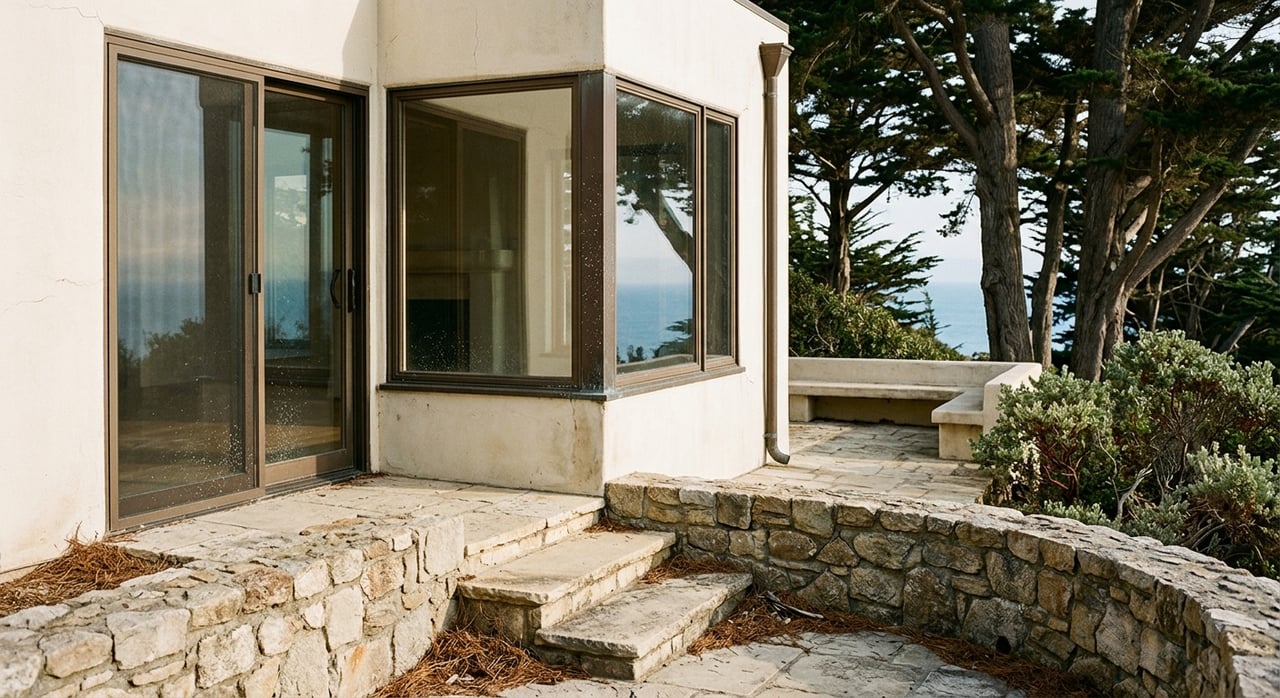
Elevation can dramatically change what you see from a home. A higher position may offer a sweeping horizon line and long-range Pacific outlook, while a lower or more recessed site may feel more protected and intimate. Neither is automatically better for every buyer, but they usually appeal to different preferences and are valued differently.
Orientation matters too. A home that faces directly toward open water may deliver a more immediate ocean experience than one angled toward a cove, hillside, or canyon. Even when both properties are near the shoreline, the daily experience of light, privacy, and view depth can vary.
This is why site-specific analysis matters so much in Carmel Highlands. Photos can make two properties look similar, but the lived experience from the primary rooms, terraces, and main entertaining spaces may be very different. In a high-value coastal market, that difference can be significant.
Why Proximity Is Only Part of the Story
Homes very close to the shoreline often command a premium, and research supports that coastal proximity can have a strong effect on value that fades with distance. Still, in Carmel Highlands, proximity alone does not tell the full story. A nearby home without a broad or lasting outlook may compare differently than a slightly inland property with a more open vantage point.
That is why buyers should think in layers. Distance to the water is one layer, but so are the openness of the sightline, the sense of privacy, and the way the home sits on the land. The strongest value stories usually combine multiple advantages rather than relying on one feature alone.
For sellers, this is equally important. If your property has an especially broad, immediate, or protected view, that distinction should be part of the pricing and positioning conversation. In Carmel Highlands, the market often rewards nuance.
Trade-Offs Behind the Premium
A stronger view does not always mean a simpler ownership experience. Coastal properties can come with added considerations that influence long-term value, planning, and peace of mind. In Carmel Highlands, some of the same features that create a dramatic setting can also introduce practical constraints.
California’s Coastal Commission says sea level rise is expected to intensify flooding, erosion, wave impacts, and bluff instability, with risks to homes, roads, utilities, and other coastal development. NOAA also notes that much of the California coast experiences active erosion. For homes near bluffs or exposed coastal edges, hazard analysis becomes part of the value picture.
Monterey County’s coastal rules also matter. Certain work in scenic corridors, improvements within 50 feet of a coastal bluff edge, and shoreline protective work can require permits and added review. If you are considering remodeling, expanding, or protecting a site, those requirements may affect cost, timing, and design flexibility.
Wastewater and septic feasibility can be another important factor. Monterey County says current onsite wastewater permits in Carmel Highlands must conform to the countywide LAMP and sewage-disposal standards. In an area already noted for shallow soils and development constraints, that is not a minor detail.
Lifestyle Factors Buyers Should Weigh
Carmel Highlands offers a sense of coastal seclusion that many buyers find compelling. At the same time, Monterey County’s plan anticipates Highway 1 south of the Carmel River remaining a scenic two-lane road and identifies long-range traffic and highway capacity constraints. For some buyers, that supports the area’s quiet, preserved character. For others, it is a practical trade-off.
Public coastal access is also part of the larger setting. California policy balances access with public safety, fragile resources, and the privacy of adjacent property owners. If a home is near an overlook, trail, or shoreline access point, that balance may shape the day-to-day feel of the property.
In other words, the value conversation is not only about what you see. It is also about how the property lives, how private it feels, and what ownership may require over time. Those details often separate a good fit from a great one.
What Buyers Should Evaluate
If you are buying in Carmel Highlands, it helps to look past the listing shorthand and evaluate the whole package. A careful review can give you a better sense of both enjoyment and long-term value.
Consider these key factors:
- View type: broad ocean panorama, layered coastal view, filtered outlook, or partial glimpse
- Elevation and orientation: how the home faces the water and where the best sightlines occur
- Privacy: whether the setting feels open yet protected
- Slope and site conditions: especially on steep or irregular lots
- Wastewater or septic feasibility: particularly for future plans
- Permitting complexity: if the property is near a bluff edge or in a scenic corridor
- View permanence: whether the outlook appears durable or depends on narrow sightlines
A home with a slightly less dramatic view but fewer constraints may be the better fit for one buyer. Another buyer may place the highest value on the most direct ocean exposure available. The right answer is often personal, but the evaluation process should stay disciplined.
What Sellers Should Understand
If you are selling in Carmel Highlands, broad neighborhood averages may not tell your property’s story very well. The market can distinguish sharply between homes with expansive, immediate views and those with more selective or sheltered outlooks. That is why pricing and positioning should start with the specific site, not just the zip code or a basic ocean-view label.
A strong valuation conversation usually looks at how your home compares on view breadth, privacy, orientation, and likely permanence of the outlook. It should also consider any property-specific factors tied to slope, wastewater, bluff proximity, or permitting conditions. In this market, those details can meaningfully shape buyer perception.
For high-end homes especially, presentation matters. When a property’s value is tied to how the view is experienced from main living spaces, terraces, and arrival points, polished visual marketing and thoughtful positioning can help buyers understand the distinction. In Carmel Highlands, that clarity is often essential.
Why a Site-Specific Strategy Wins
The clearest takeaway is simple: Carmel Highlands is not a one-note ocean-view market. It is a coastal enclave where topography, regulation, exposure, and ownership considerations all intersect. Two homes can look comparable at first glance and still belong to very different value stories.
That is why buyers and sellers both benefit from a site-specific strategy. You want to understand not just whether a home has a view, but what kind of view it has, how protected it is, and what trade-offs come with it. In a market this nuanced, careful local guidance can make a meaningful difference.
If you are weighing a purchase, planning a sale, or simply want a clearer read on how a Carmel Highlands property fits into today’s market, E&V Carmel Shop can help you evaluate the details with local perspective and a consultative approach.
FAQs
What makes ocean views in Carmel Highlands vary so much?
- Carmel Highlands has steep topography, varied elevations, different orientations, and county view-preservation rules, so nearby homes can have very different outlooks and value profiles.
Do all ocean-view homes in Carmel Highlands have the same value premium?
- No. A broad, unobstructed, and more immediate ocean view usually carries a stronger value story than a filtered, partial, or more distant outlook.
What should buyers review beyond the view in Carmel Highlands?
- Buyers should review slope, privacy, orientation, wastewater or septic feasibility, permitting constraints, bluff proximity, and whether the view is likely to remain consistent over time.
Are bluff-top Carmel Highlands homes harder to remodel?
- They can be. Monterey County regulates certain work in scenic corridors and improvements within 50 feet of a coastal bluff edge, which can add review and design considerations.
How does coastal risk affect Carmel Highlands property value?
- Coastal risk can matter because sea level rise, erosion, wave impacts, and bluff instability may influence long-term ownership considerations, planning, and buyer demand.
Why is pricing a Carmel Highlands home so property-specific?
- Carmel Highlands often functions like several small submarkets, so pricing depends heavily on the exact view quality, site conditions, privacy, and regulatory context of the individual property.